66
LNG
INDUSTRY
OCTOBER
2016
Other safety codes now in place include the National Fire
Protection Association’s NFPA 57 for vehicular LNG piping
and NFPA 59 for LNG production, storage, and transfer.
The Society of Automotive Engineers (SAE) has created an
LNG code J2645 for vehicular system recommendations.
The Department of Transportation also addresses safety
with regard to LNG-powered vehicles. Beyond these, there
are 12 additional prominent organisations that offer safety
recommendations for the use of LNG.
2
These include,
but are not limited to, the American Gas Association,
Underwriters Laboratories, National Institute of Standards
and Technology, and the American Petroleum Institute (API).
Today, most owners and operators of LNG systems have
learned that safety is essential from both a moral
responsibility perspective and a litigation point of view.
Essentially, it is unwise to use LNG pipe and pipe systems
that are not designed, manufactured, installed and operated
in accordance with acknowledged good practices and well
known standards. Safety is ultimately the system owner’s
responsibility. The ASME B31.3 code states that: “The owner
of a piping installation shall have overall responsibility for
compliance with the code, and for establishing the
requirements for design, construction, examination,
inspection, and testing which will govern the entire fluid
handling or process installation of which the piping is a part.
The owner is also responsible for designating piping in
certain fluid services and for determining if a specific quality
system is to be employed.”
3
In some US states and
Canadian provinces, pipe systems are mandated by law to
be put into service in accordance with ASME B31.3. Thus,
safety is mandated and violators will be punished. It is also
good practice for the system owner to specify the system to
be in compliance with NFPA standards, which describes
definite requirements for additional safety.
What do all of these codes mean to the prospective
buyer of an LNG pipe system? Firstly, it means that it is the
owner’s moral, and sometimes legal, obligation to comply
with the codes by using piping and piping components
certified in writing as code compliant. Secondly, it means
that the owner will be assured that the selected system will
be safe within all reasonable means, provided that it is
purchased from a reputable code compliant provider.
NFPA 59
By complying with NFPA 59, the buyer is assured of the
following:
The piping is designed and built in accordance with
ASME B31.3.
The LNG containment and storage vessels are built in
accordance with ASME Section VIII.
The piping and pipe supports are designed to meet
specified seismic requirements.
The pressure relief valves are designed to adequately
relieve the system pressure in case of fire using
Compressed Gas Association formulas.
The gaskets, sealant, and materials are code compliant.
The installation performed is code compliant, e.g. all
cryogenic valves are angled at no more than 45° from
vertical.
ASME B31.3
If a provider complies with ASME B31.3, the buyer is also
assured of the following:
Designer qualifications: the designer that is in charge
of the engineering of the piping system must hold
an accredited engineering degree, be a professional
engineer, hold a two-year engineering technician’s
degree, plus 10 years of relevant experience, or have
15 years of design experience that includes pressure
calculations, load calculations, and pipe flexibility
calculations.
Material traceability all the way back to the mill.
Certified welders with appropriate documentation.
Certified weld procedures for every ASME weld.
Inspected welds examined to the customer’s
pre-determined requirements including, at the owner’s
request, 100% radiographing or other examination
procedure.
All examinations preformed by a Certified Weld
Inspector (CWI).
All components, including valves, meet the
requirements of B31.3 or referenced codes and are
plainly labelled.
Functional pressure testing and written certification.
Piping designed to meet the owner’s thermal cyclic
requirements.
Code compliant written certifications for file.
Copies of all calculations including the maximum
allowable working pressure (MAWP) and the pipe
support system stresses.
Test reports showing thermal cycle testing.
Selecting a provider
It is advisable to request to see the provider’s ASME Pipe
Quality Manual. The provider should also supply valves that
are clearly labelled as B16.34 compliant and all relief valves
should be tagged as certified ASME compliant.
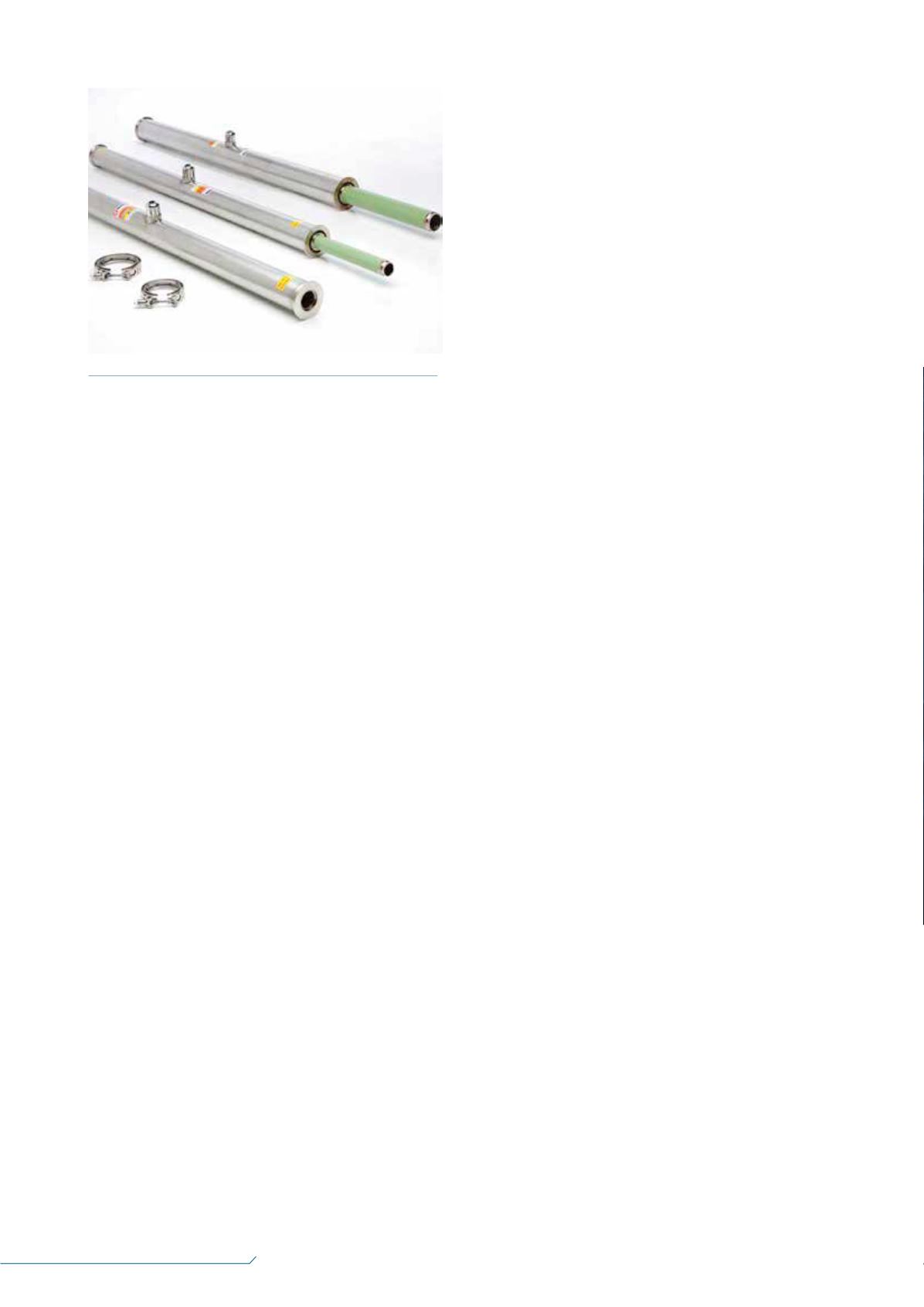
Figure 1.
Technifab Techniguard Vacuum Jacketed Pipe.
C
M
Y
CM
MY
CY
CMY
K


