56
LNG
INDUSTRY
OCTOBER
2016
power generation and utilities, there is a new trend in the use of
LNG as a transportation fuel for trucks, trains and ships, instead of
diesel and heavy fuel oil (HFO).
New developments meet
increasing demands
Brazed plate heat exchanger (BPHE) technology has existed
for over 30 years and has served in multiple industries, with
the majority of sales in heating, ventilation, air conditioning and
refrigeration (HVAC&R) applications. With a normal operating
range from -196°C to +225°C and an ability to handle pressure in
the range of 40 bar, a BPHE is compact and has lowmaintenance
requirements. These characteristics are ideal for the handling of
liquefied gases. However, until now, the LNG industry has not
been able to fully utilise this technology in terms of capacity,
pressure and its common multi-stream arrangements.
What has changed is not only that the demand on the LNG
industry for small scale solutions has increased, but that there
have been significant developments in heat transfer technology
in recent years. The material race started 10 years ago, but 100%
stainless steel products have only been available frommost
producers in the last three years. Today, more exotic material
combinations for various corrosive fluids are entering the BPHE
market as well.
Approximately five years ago, the first products with seriously
asymmetric plate designs entered the market and it is anticipated
that more sophisticated solutions for a variety of applications will
be developed in the years to come. Simultaneously, there are
now BPHEs that are able to withstand 140 bar without any
external support structure and this development is spreading to
higher capacities. This is a giant leap for BPHE technology, as is
the step change in capacity where 4 in. pipes defined the
maximum capacity of this technology for over two decades.
Since SWEP, a Sweden-based company that specialises in BPHE
technology, introduced its 6 in. series in 2012, new opportunities
have opened up in the design of systems operating up to 30 bar.
In recent years, the small scale biogas liquefaction market
has established itself. Boil-off gas (BOG) liquefaction for new gas
carriers has become close to standard and a market has formed
for small scale upstream liquefaction.
The mixed refrigerant (MR) cycle is beginning to win ground
and there is a booming demand for LNG as a fuel for ships, trucks
and trains in isolated markets. Today, BPHEs can be found in
various midstream liquefaction systems, such as BOG for LNG
vessels and terminals, as well as in filling stations. BPHEs have
also proven reliable in the upstream sector with LNG and LBG
onsite production. They have also entered the LNG vaporiser
market.
Modular thinking for high
flexibility
Re-liquefaction of BOG from gas carriers for LNG/LEG/LPG
requires energy-efficient cooling without high CAPEX that might
deter some actors from using re-liquefaction systems, and it
requires a minimum of maintenance. With the basic elements of
a standard lubricant injected screw compressor and a number of
BPHEs, the modules can be combined in the most suitable way
to operate with a tailor-made mixed component refrigerant. The
BPHEs, used in the liquefaction system, play a vital part in the
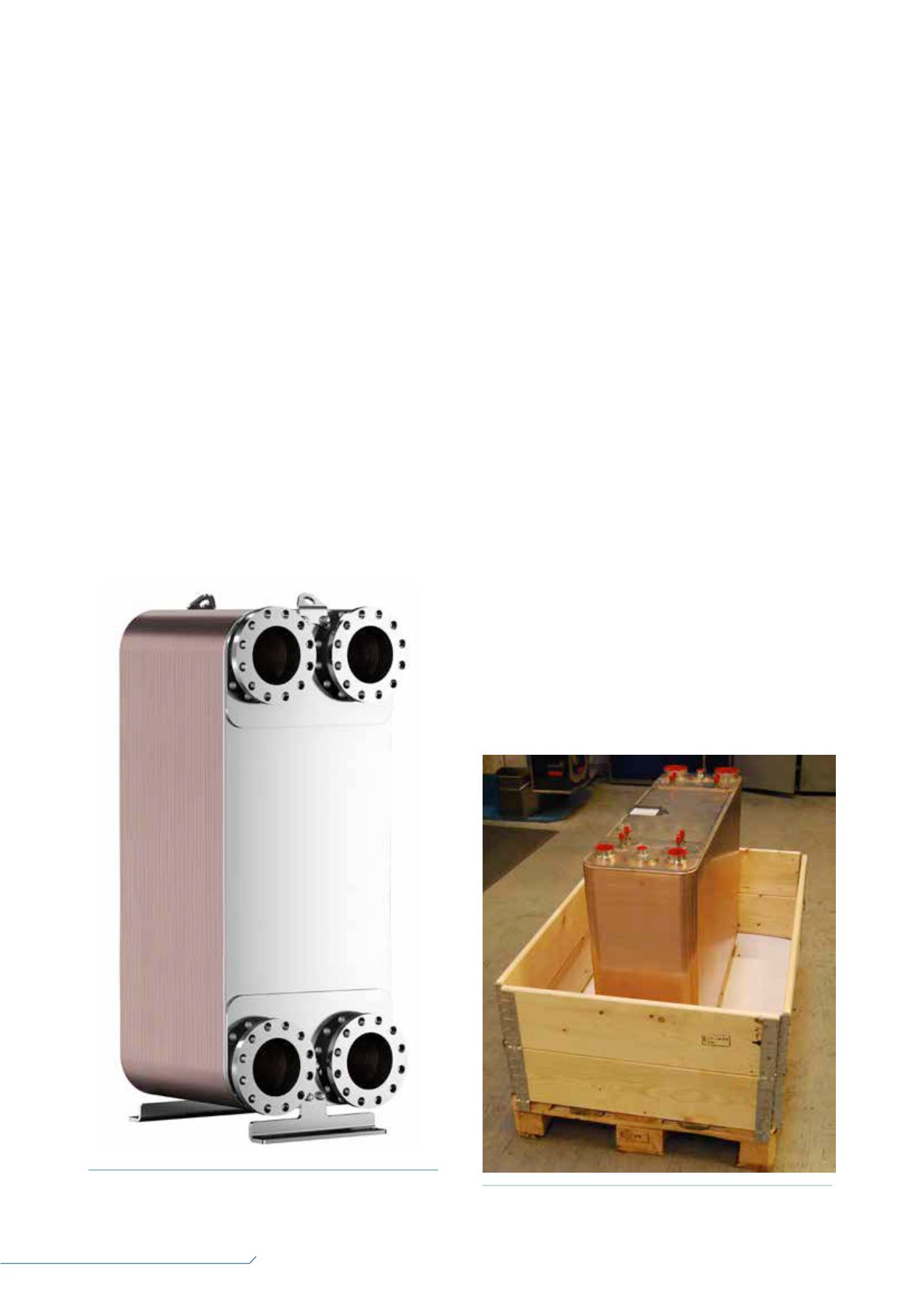
Figure 1.
A compact yet powerful brazed plate heat exchanger
(BPHE).
Figure 2.
A BPHE is easy to transport and store.


