58
LNG
INDUSTRY
OCTOBER
2016
largest BPHEs, which proved successful. Today, almost half of
the fleet is able to handle -163°C with BOG re-liquefaction for
LNG, thus able to transport LNG, LPG and ethylene. The compact,
yet reliable, BPHEs handle the cooling procedure with a
minimum of maintenance.
Looking ahead
Several actors on the market, often in collaboration with
universities and research institutes, are striving to further
develop the micro and mini LNG concept. The micro LNG
supply chain is strengthened through partnerships with plant
providers, thereby developing complete solutions for the entire
plant. It is expected that growth in micro LNG plants will trigger
a lucrative market opportunity for process equipment suppliers
in the next five years.
2
It is possible to further decrease the size and weight of LNG
plants. There is a tendency in the market to move towards ever
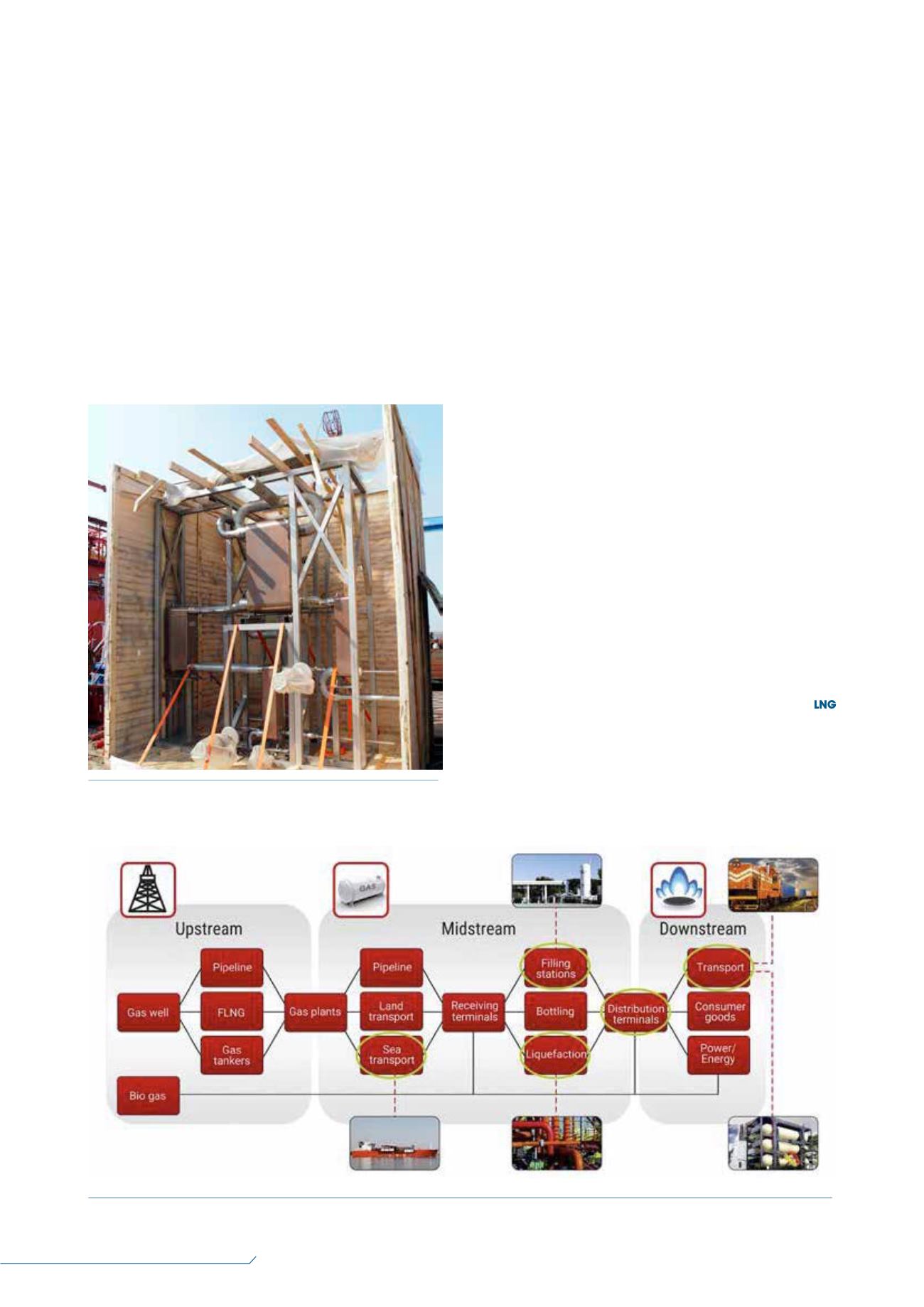
Figure 5.
A BOG module before the installation on an LNG
vessel.
Figure 6.
BPHE use expands in the LNG value stream
smaller systems, frommini LNG to micro LNG, in order to
accelerate the use of an abundant natural resource for
cost-effective and cleaner fuelling in a variety of applications. A
containerised micro LNG plant can easily be connected to the
process pipework of a larger production facility. Modules for
various functions can be further optimised and make it possible
to install a purpose-built plant for a specific application – a
strategy that several players on the market have already
implemented. Naturally, such modules have to be flexible for
various operating conditions and offer a highly competitive
performance, which is a tough challenge for both the system
designer and the component manufacturer.
Conclusion
Recent years have seen an increase in the small scale
LNG market and a growing demand for LNG as a fuel for
ships, trains and trucks. Simultaneously, there has been a
considerable development of the BPHE technology. Today,
BPHEs can be found in various midstream liquefaction
systems, such as BOG for LNG vessels and terminals, as
well as in filling stations. BPHEs have also proven reliable in
the upstream sector with LNG and LBG onsite production,
as well as the LNG vaporiser market. Based on standardised
industrial components, such as BPHEs and refrigeration screw
compressors, the micro LNG concept offers advantages such
as flexibility, compactness and modularity, which decreases
CAPEX and lead times. Light and compact, it is easy to
transport, which also benefits the relocation of the plant to
remote areas that do not have access to pipelines or cannot
afford the high CAPEX of a larger LNG plant. The micro LNG
concept also ensures long-term utilisation in an industry with
shifting supply and demand.
Ever smaller and more energy-efficient systems for gas
production, transportation and consumption are being
developed for the future benefit of the global environment.
References
1. SATRIAGO, H., ‘The increasing role of gas in the global
energy mix’,
The Jakarta Post,
(17 June 2015).
2. Frost & Sullivan, ‘North American Micro LNG – Small
Scale – Big Impact’, ID: 3129714, (March 2015).


