OCTOBER
2016
LNG
INDUSTRY
57
development of the SINTEF micro LNG concept. SINTEF Energy
Research has shown that BPHEs fit well into this concept and
can withstand rapid temperature changes. Having first applied
the method full-scale on board a multigas carrier in 2009, the
SINTEF research shows that the installation of a micro LNG unit
is both environmentally and financially sound.
Amicro LNG liquefaction plant often focuses on local
distribution where LNG is regasified and fed as pipeline natural
gas for local power generation, but the technology and the
concept is essentially the same as for marine BOG
re-liquefaction, with LNG filling stations connected to the gas
grid, or LBG production at a landfill site. The BPHE technology is
also a key component for cost and size efficient MRmicro LNG
systems. Small scale LNG plants have been acknowledged as
the best option for monetising marginal and stranded gas
reserves.
1
By compacting gas volume up to 600 times denser
than the standard atmospheric pressure, an LNG plant is the
safest and most efficient way to utilise natural gas.
The theory with a micro LNG plant is to standardise the
components, which substantially decreases manufacturing lead
times. With an off-the-shelf strategy, the components of the
heat exchanger can be combined into custom-made installations
at a lower investment. The plants can easily be packed up and
relocated to a new gas resource. Previously, the natural gas
sector had to choose between expensive low volume
components, or whatever mass produced parts were available,
but SWEP can now customise its existing range to fit the specific
needs for liquefaction, and can develop new products for the
LNG vaporiser market.
Unlike large capacity technologies and even mini LNG
systems, the micro LNG plant is commercially able to recover
waste gases from various organic processes, and in remote
areas. Biogas, flare gas, landfill and coal bed methane (CBM)
have so far not always been financially viable, but the micro LNG
concept allows for quick adaptation for projects where it is not
technically or economically feasible to build pipelines to
end-users. Turning previously unutilised reserves of gas into
liquid fuels decreases carbon footprint while meeting the
increasing demand of the market. One example of this is
North Dakota, US, which recently adopted tough new
restrictions on gas flaring. Much of the natural gas produced
alongside the crude oil production has been burned off at
thousands of wells, since inadequate pipeline and gas
processing infrastructure have made it impossible to capture the
gas. Amicro LNG plant would make it possible to utilise this
source of energy.
When it comes to retrofitting equipment in restricted spaces
and transportation of pre-produced racks with rail or truck to the
customer, the smaller size and decreased investment cost of a
micro LNG system is beneficial. With compact components, it is
possible to utilise existing vessels and to use other means of
transportation than across the sea. The adaptation of selected
equipment, MR and operational conditions for each application,
as well as natural gas composition, also allows for customised
solutions in older vessels.
The MR system has recently also been introduced in the
cargo handling product line-up fromWärtsilä. The company
claims that, for conventional LNG carrier capacities, MR
re-liquefaction technology is the most cost-effective solution,
and for these systems, BPHEs offer both an attractive price and
short lead times.
Case study
Norgas Carriers Private Ltd, a member of the
I.M. Skaugen Group, is a leading integrated shipping company
involved in the global transportation of petrochemical gases,
LPG, chemicals and LNG. The company has recognised the
growing need for environmentally friendly transportation and
fuel usage. In the past, Norgas vessels were designed for short
haul, and for cargo at a temperature of -104°C, which means
liquefied ethylene, but not methane. The re-liquefaction capacity
was only sufficient to maintain tank temperature and pressure
after loading. Later, the company developed vessels for long
haul with super coolers that were not only able to maintain the
temperature of the cargo, but also cool it down 2.5°C per day.
However, Norgas sought further improvement. Over the
years, the company has increased the cooling capacity, from
super coolers to winter coolers and multigas. In late 2009, the
first full scale plant for marine applications was installed on
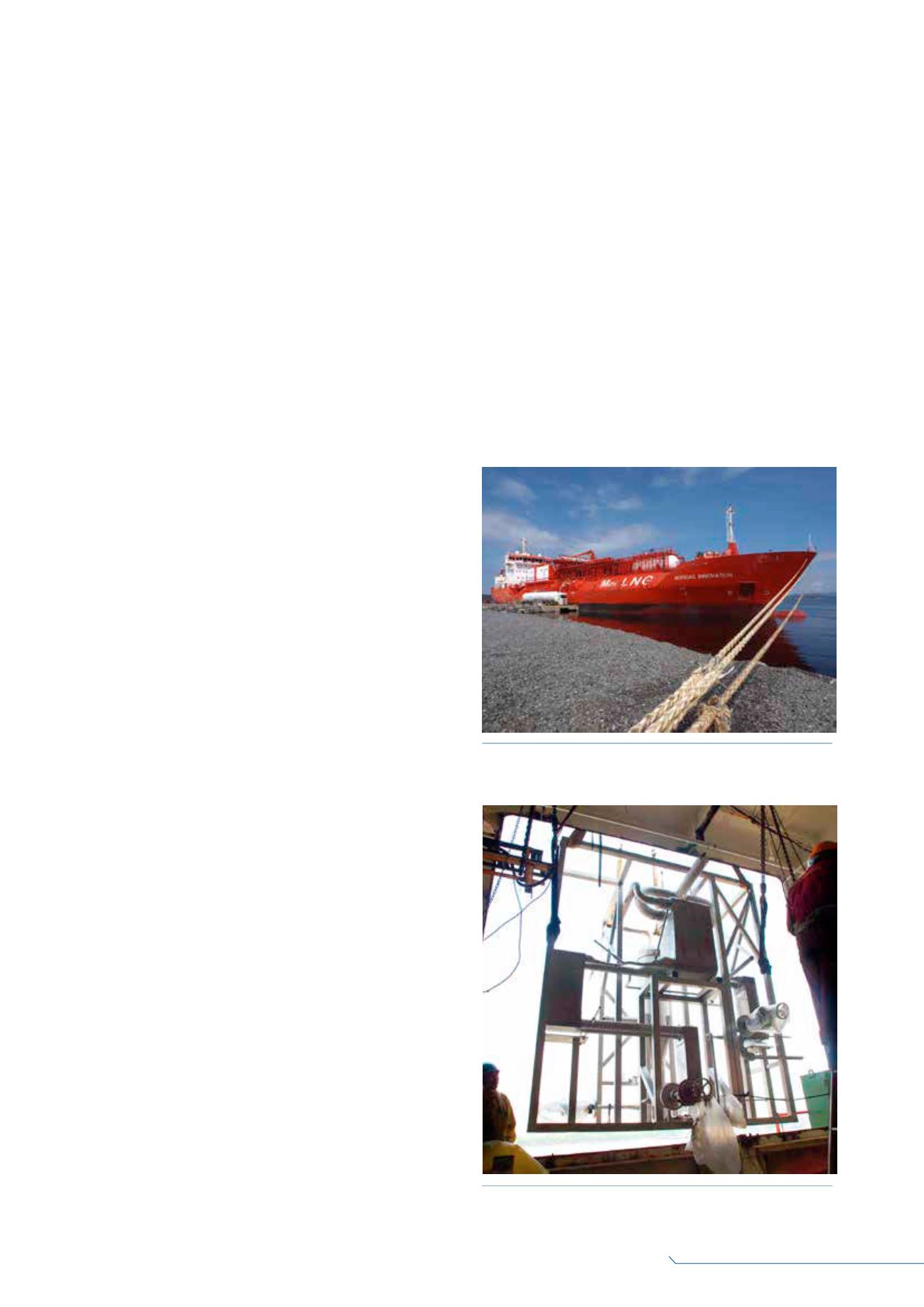
board the multigas carrier,
Norgas Innovation
, in cooperation
with SINTEF and SWEP.
Norgas Innovation
featured SWEP’s
Figure 3.
Norgas Innovation
with a pioneering boil-off gas
(BOG) system.
Figure 4.
Retrofit installation of a BPHE-based BOG system.


