70
LNG
INDUSTRY
OCTOBER
2016
Challenges in detailed design
There are a number of challenges to consider when
designing pipe supports for cryogenic applications,
including the following:
The length and diameter of pipes shrink and expand with
each change in temperature.
Any insulation material used as an insert will shrink
differently to the pipe in terms of thickness, length and
diameter.
The support fastening system, which is separated from
the pipe by means of an insulation material, is subjected
to the changing ambient conditions and also shrinks and
expands.
Due to a water vapour pressure differential caused by the
temperature differential over the insulation, moisture is
driven into the insulation towards the pipe.
Vibration and shock resistance.
From an economical point of view, it seems logical that
standard pipe support designs, as used for non-insulated
pipes, are suitable when it comes to resting supports,
slides and guides. An insulator is required between
cryogenic pipe and the metal cradle. The choice of
insulation material depends upon the combination of
both insulation value and physical properties. However,
it can be difficult for a material to have the physical
properties to resist loads, while also providing an
adequate insulation value.
In the 1970s, hardwood (oak, irocco, okoume and
merbau) blocks were used extensively in cold
applications as loadbearing inserts between the pipe
support and the steel pipe due to the material’s
combination of high compressive strength and insulation
properties. These inserts, which were of a 60° or 90°
design, were placed between pipe and pipe
clamps. Non-loadbearing insulation, such as
cork, was used in the remaining space between
the clamp and the support.
Not only was this design proven to be
inadequate in terms of thermal performance,
but moisture ingress and icing also occurred
after only a short period of operation,
defeating its purpose.
Polyurethane was discovered by
Dr. Otto Bayer around 1930, and higher
densities in rigid foams were developed
around 1950 – 1960. The manufacturing
technique includes block forming and cutting,
injecting, spraying and precision molding.
In 1973 – 1974, R&D work resulted in a high
density precision molded polyurethane
product with high density skins as loadbearing
insulation for cryogenic supports. The unique
features of this product were that it combined
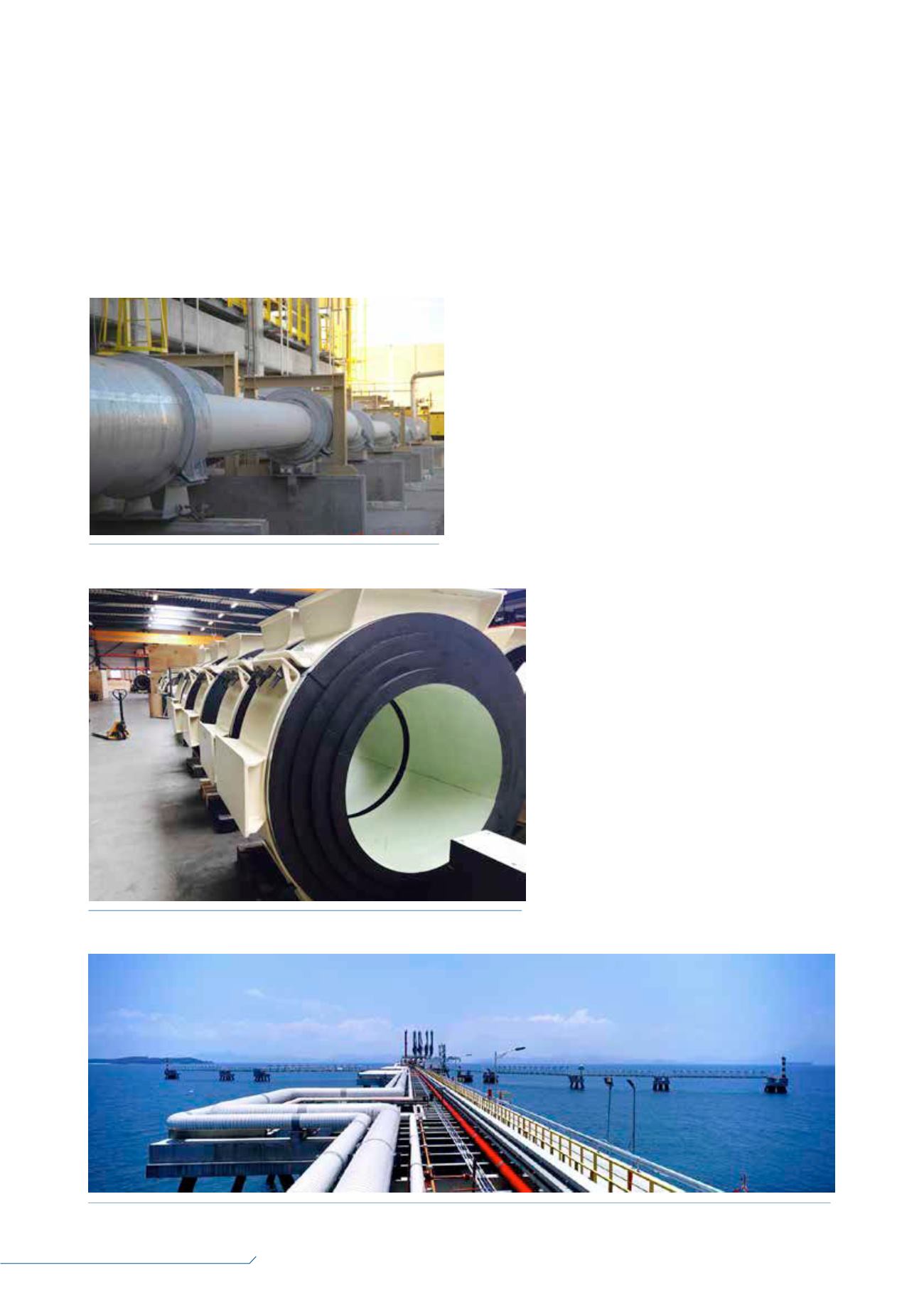
Figure 3.
Guangdong LNG terminal; China’s first LNG receiving terminal (courtesy of Saipem).
Figure 2.
Yamal LNG; 36 in. cryogenic supports awaiting inspection.
Figure 1.
Sagunto LNG terminal.


