



 48 / 60

46
January 2020
IMO Type C LNG fuel tanks
International Maritime Organization (IMO) Type C tanks
have until now been chosen due to a lack of alternative
LNG fuel tanks designed to withstand increased pressure
loads. Type C bi-lobe and even tri-lobe are offered for the
combination of high fuel volume and pressure tolerance for
ship types such as large containerships, cape size bulkers,
very large crude carriers (VLCCs) and car carriers.
Type C tanks need, per regulations, to be designed for a
pressure higher than 2 barg, depending on the tank size,
with larger sizes giving higher minimum design pressure. In
many cases, this does mean using more tank steel than
needed with regards to restrictions in weight optimisation.
Due to the rounded form of Type C tanks, there are further
restrictions in volume efficiency.
Prismatic LNG fuel tanks
The market has responded to the restrictions relating to
the IMO Type C tank by choosing very large, prismatically
formed LNG fuel tanks – the CMA CGM container
ships project in China being one high-profile example.
Furthermore, there are now different types of prismatic
fuel tanks hitting the drawing board for several other
large scale LNG fuel tank projects.
Prismatically formed LNG fuel tanks (i.e. membrane
types, IMO Type A and IMO Type B) have high volume
utilisation, but IMO regulations have restricted their pressure
capacity to an upper limit of 0.7 barg. For many projects, an
operation pressure limit of 0.7 barg is too low. One concern
is the holding time capability, which requires that the ship
be able to remain in an idle condition for 15 days without
venting gas. Other concerns relate to various operational
factors, such as how cold does the LNG need to be to avoid a
build-up of excessively high pressure in the tank after
bunkering? How quickly is it possible to bunker within the
limited pressure inside the tank? Movements inside the tank
in rough weather may cause a rapid increase in pressure;
how can this be handled within the 0.7 barg pressure
margin?
A solution to this problem is to fit boil-off handling
equipment, which can become expensive and power
demanding.
Pro and contra considerations for Type A, B, C and
membranes reveal that volume efficiency, steel weight and
tank pressure are strongly influencing the investment and
operation costs associated with using LNG as fuel.
Novelly designed LNG fuel tanks
LNG fuel tanks that are constructed according to available
ship volumes, and at the same time can tolerate a pressure
above 0.7 barg, were not accepted in the earlier revisions
of the IMO International Gas Carrier (IGC) Code. In the
latest revision, LNG tanks of novel design have finally been
introduced.
Novelly designed LNG tanks create the opportunity to
combine prismatically formed tanks and pressure build-up
possibilities, with the freedom to choose tank design
pressure. A thorough design and safety philosophy is a
prerequisite for getting authority and class approval for
novel designs. This design method is called ‘limit state
design’.
Briefly described, the reliability and safety of a novelly
design tank, under increased pressure, shall be equivalent or
better than the prescriptive tank types defined in the
IGC Code.
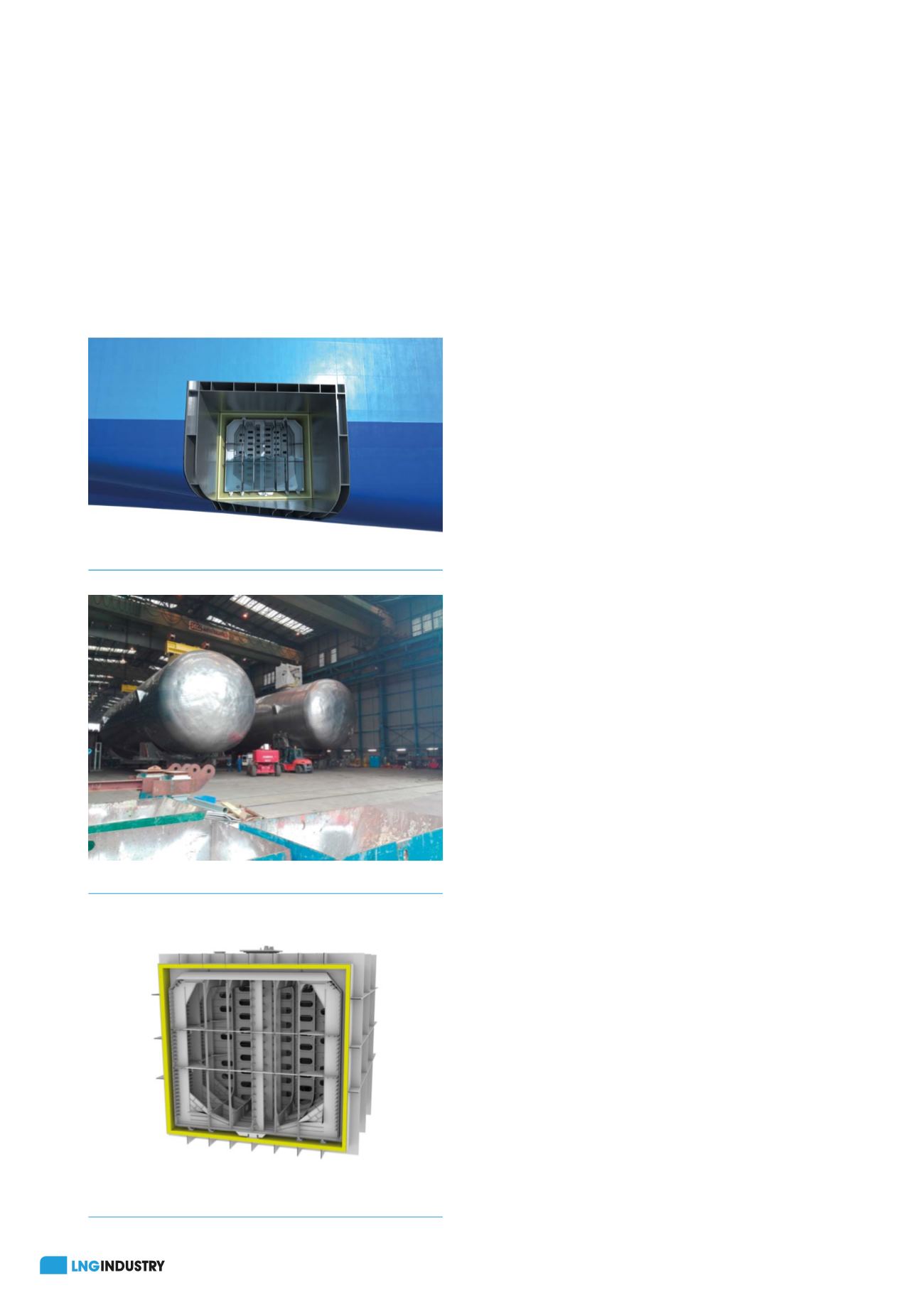
2 barg pressure prismatic LNG
fuel tank
LNT Marine specialises in prismatically shaped marine
LNG tanks and LNG tank insulation. The company’s novelly
designed LNG tank, which is called the LNT Fuel-Box, has
been developed in close cooperation with the classification
society ABS. As a result of this cooperation, ABS issued an
approval in principle (AiP) for the LNT Fuel-Box in 2019.
Figure 1.
Prismatically formed LNG fuel tank.
Figure 2.
Foam insulated IMO Type C fuel tanks.
Figure 3.
Arrangement of an LNT Fuel-Box.