54
LNG
INDUSTRY
OCTOBER
2016
High capacity vane efficiency
Standalone single and double pocket vane performance is
typically in the range of 15 – 50
µ
m. A mesh type preconditioner
enhances the mist eliminator performance. This design is
often sufficient to meet the common performance target of
the removal of 99.9% of 10
µ
m
droplets and larger, but only
with the inclusion of the preconditioner, which operates in the
flooded regime, saturated with liquid. Mist-laden gas enters the
preconditioner, which intercepts and collects the fine droplets.
The collected droplets coalesce into much larger droplets. The
larger droplets are entrained into the vane mist eliminator and
removed.
The total flange-to-flange pressure drop for this application is
less than 0.75 psi.
The difference between the gas and liquid density provides
the driving force for the collection of suspended droplets. The
physical properties of the liquid – particularly density, viscosity
and surface tension – have a significant impact on the retention of
collected liquid.
For example, an exceptionally high viscosity liquid will drain
slowly, which will reduce the total liquid load that the vane
pockets may accept before filling completely. The vane
performance decreases dramatically if the drain pockets are full of
viscous liquid or solid fouling. Since liquid viscosity is directly
related to themaximumdrainage rate, the designer should
consider splitting the vane bank into shorter vertical sections with
intermediate drainage troughs. Themaximumheight of a single
vane pack should be between 4 and 8 ft.
Another example is a low surface tension liquid. Here, the
liquid droplets impinge upon the vane surface andmay shatter,
sending small droplets that are difficult to capture back into the
gas stream. The filmof liquid that remains on the vane surface is
also at risk of shearing into the gas stream. Gas load factors are
empirical values developed by themanufacturers for their own
specific products. It is important to reduce the design k-value if the
liquid surface tension is exceptionally lower than the test liquid
used to develop the data.
Vanes experience a sharp decline inmist removal efficiency
upon flooding. Once the gas velocity is sufficient to shear liquid
from the blade surface, or the liquid drain path is choked, liquid
can no longer reach the drain trough. This means that the liquid
exits the vane with the discharging gas, in the formof
re-entrainment.
A new approach
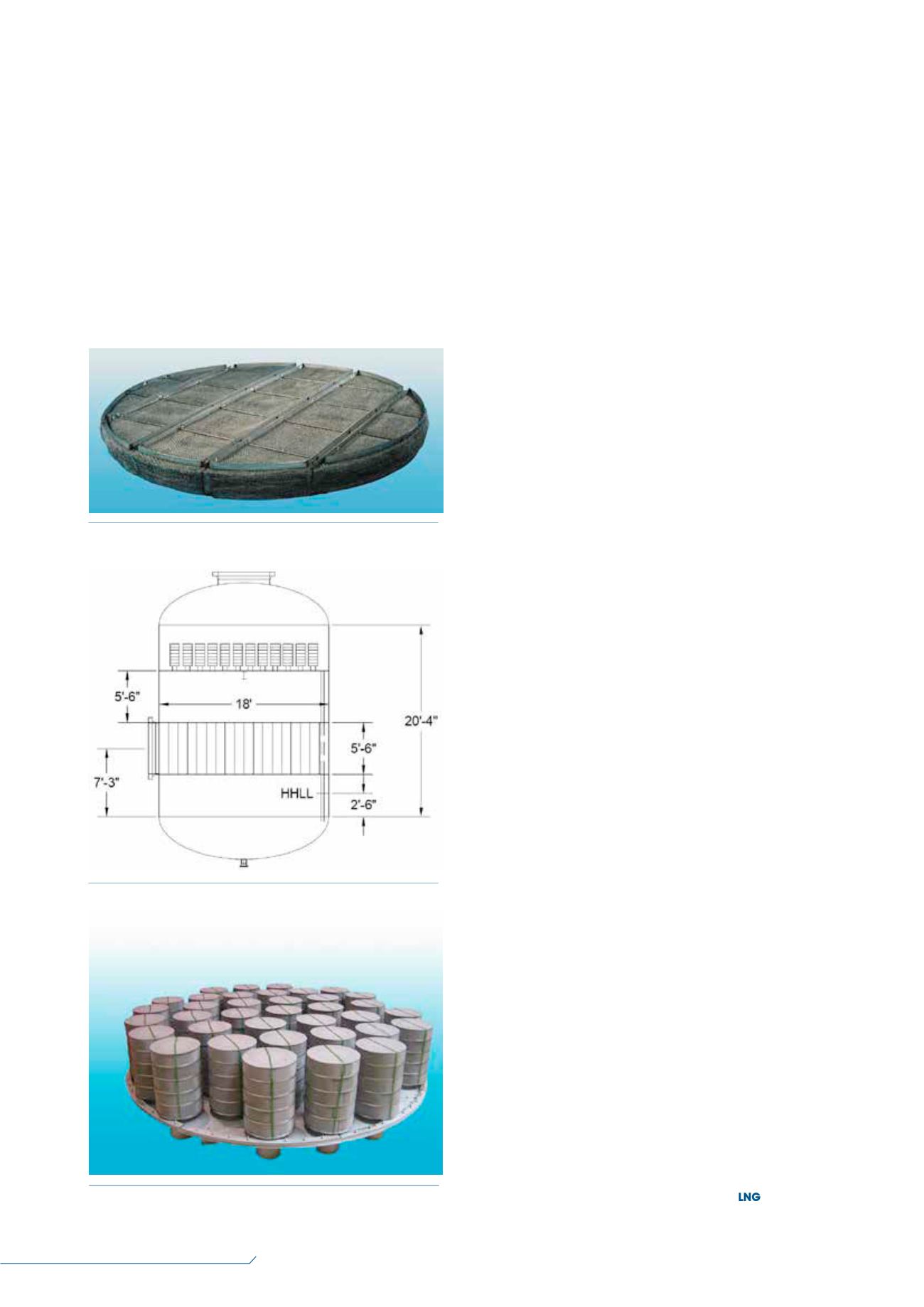
A bank of cartridgemist eliminators is another option. The
Sulzer MKSMulti Cassette
TM
mist eliminator uses stacked
cassettes in parallel to providemore flow area than the vessel
cross section. The design gas load factor is similar to a mesh pad,
but the outer surface area of each cassette can be considered. The
required flow area can be achieved with 864 cassettes that will be
stacked on a minimumnumber of individual cylinders.
In this example, themist eliminator requires a similar diameter
as the twin box vane arrangement, but reduces the required vessel
height by 50 in. compared to the twin box vane arrangement.
To fit within an 18 ft dia. vessel with a 3 in. wide perimeter ring,
the cylinders aremounted on a support tray with a centre support
beam, and the support tray is split into panels to pass through the
vessel manway.
TheMulti Cassettemist eliminator can provide collection
efficiency of 99.9%of 8 – 10
µ
m droplets. Amesh preconditioner
may augment efficiency. Unlike vanes, there is no limitation on
operating pressure.
The total flange-to-flange pressure drop for this application is
less than 1.0 psi.
This design has been successfully retrofitted into existing
knock out drums without welding. The supplier designed the
internals to utilise the existing support ring and fit within the
available vertical space. One of the retrofit vessels has been in
operation since 2009.
Sulzer uses a thorough design review for all separator
optimisation operations, including several low pressureMR
suction knock out drums currently in fabrication.
Figure 5.
Sulzer MKS Multi Cassette mist eliminator.
Figure 4.
Sulzer MKS Multi Cassette elevation.
Figure 3.
Sulzer knitmesh mist eliminator.


