44
LNG
INDUSTRY
OCTOBER
2016
Increasingly, these players buy volumes with no destination
constraints. Instead, their market strategy is to create value
from LNG logistics, leveraging storage, infrastructure and
shipping to bring agility and economies of scale that takes
advantage of shorter-term markets. At the same time,
long-standing commercial arrangements are in review and
purchasing behaviour is now favouring shorter-term, smaller
volume and best market price bids. A case in point is Japan’s
Jera Co. Inc., which is now planning a 42% cut in its long-term
contracts to 2030. It is easy to see why many are heralding
the arrival of a buyers’ market.
Game changer
A major knock-on effect of this shift in power is the
uncertainty and risk that this brings to LNG project
developers, regasification terminal developers, end users
and LNG buyers alike. Many precedents on market strategy,
market analysis and project due diligence no longer apply,
and, as a consequence of this uncertainty, the LNG newswire
has become dominated by delays, rethinks and cancellations.
As is the case with most industries, if an end user’s
supply options grow, producers must respond with more
flexible, competitively effective volumes, delivery lead times
and pricing terms. As commercial arrangements adapt to the
new market reality, previous barriers to market entry are also
lowered. Those new buyers and projects previously screened
out are able to re-enter the game.
Although in the immediate future, risks need to be limited
with regards to potential project structures, economics and
financing, there are also opportunities to be taken.
LNG producers need to improve operational and cost
efficiencies to earn their share of this rapidly changing
market, providing competitively effective options to end
users. However, in addition to becoming more streamlined
and agile, businesses must now navigate through a field of
tough decisions about key elements of their business
strategy. That means inserting into the usual planning
cycles a process of exploring future business options, stress
tested against expected challenges, to build solid evidence
of future operational control using specialist modelling
studies.
Solution
Well aware that they cannot afford to take unnecessary
risks or incur excessive timescales and escalating costs,
many LNG players have turned to modelling as the best
way to optimise future operations. For many, this means
relying on complex spreadsheets to try to imitate real
world conditions that naturally change over time. As market
uncertainty dominates, these spreadsheets are being
pushed to their limits to calculate the ‘what-if’ numbers. This
analysis is flawed, having been based upon spreadsheet
averages-upon-averages, and does not deliver the certainty
that stakeholders now demand.
For example, it would be a brave business that made
decisions about its annual delivery programme (ADP) and
schedules without accounting for the uncertainty and
variability across such factors as:
Production output.
Shipping weather conditions.
Tides, daylight restrictions and channel traffic effects on
berthing times.
Fleet mixes (vessel size and speed).
Seasonal demand profiles across geographies.
These factors are all inherently difficult to analyse using a
static calculation, and have knock-on effects, feedback loops
and can cancel each other out in unexpected ways.
Financial backers and project partners are becoming
more discerning about what they consider as proof that a
given strategy will provide the rewards promised, and,
therefore, all of these factors need to be considered. As
sophisticated consumers of information, they are looking for
fact-based scientific analysis to prove the viability of
proposals. They are looking to literally see their future
business and experiment with it, in a real world picture, to
understand the sensitivities, risks and key performance
drivers.
In the same vein, as a key part of their contractual
scrutiny, end users and buyers expect to see producers and
marketers bring compelling proof that all the angles and
uncertainties have been considered.
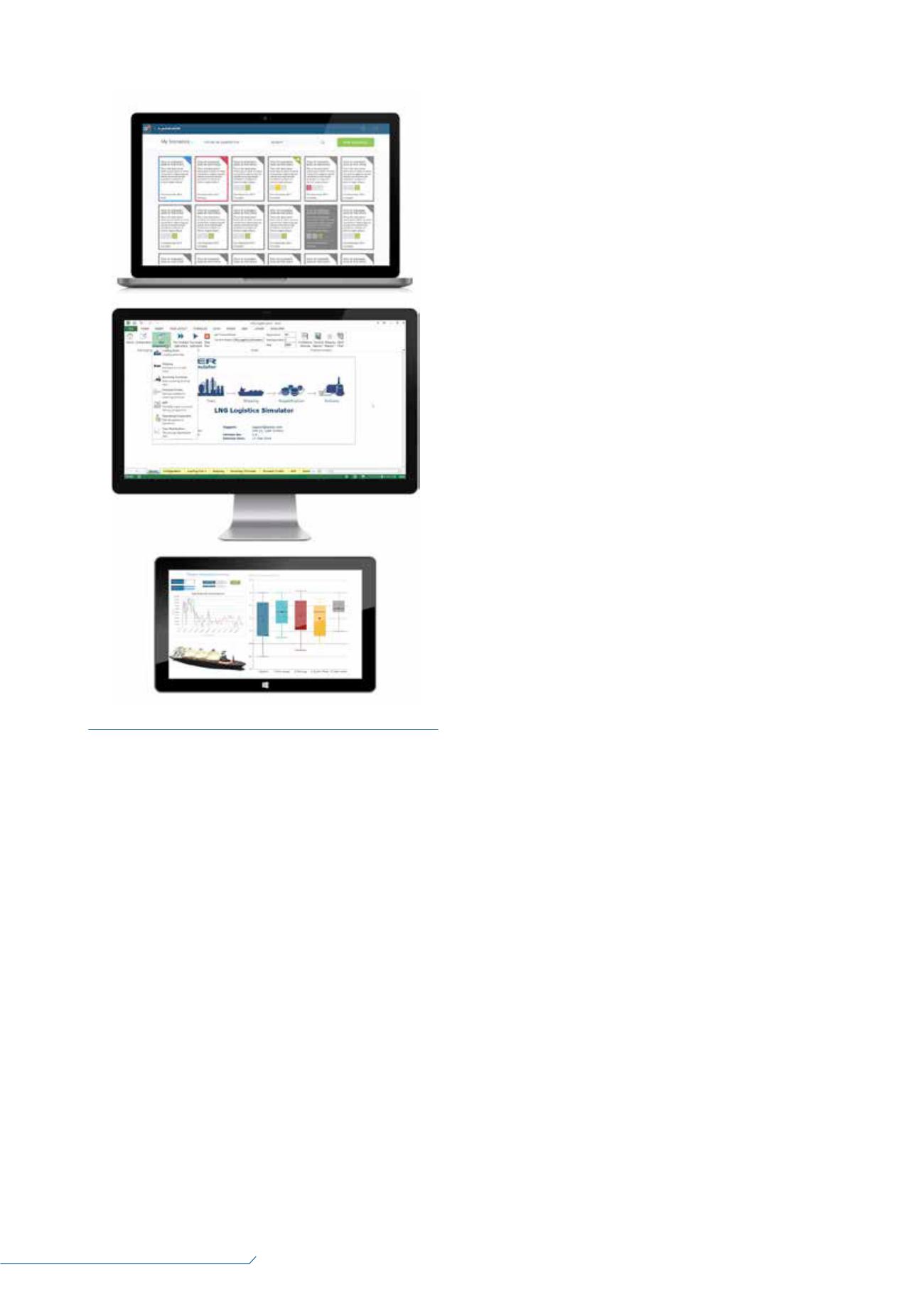
Figure 1.
Configurable simulation assets allow many scenarios
to be considered.


