40
LNG
INDUSTRY
OCTOBER
2016
To support continuous development and growth,
Cheniere was interested in finding a way to automate
workflows and streamline manual processes for LNG and
commercial services operations.
Automating commercial
operations
In the past, spreadsheets were the primary tool for building
and maintaining ship schedules and for communicating
these between LNG sellers and buyers. By the time those
spreadsheets are constructed and sent out, the data has
become out of date.
Cheniere began looking for a transaction management
application for vessel scheduling, customer interaction, and
inventory management. The company also required a
measurement accounting tool for natural gas, as well as a
solution to manage pipeline business transactions with
shippers. To support its expanding LNG and terminal services,
Cheniere implemented an integrated solution that includes
the following commercial software applications:
LNG cargo and inventory management.
Pipeline transaction management.
Gas measurement.
Field measurement.
Query and reporting.
As a result, the
company was able to
modernise and automate its
entire LNG cargo
management process.
Benefits include
improvements in generating
customer reports and in
maintaining compliance
with industry measurement
standards, such as
American Petroleum
Institute (API), Gas
Processors Association
(GPA) and American Gas
Association (AGA), as well as financial reporting
standards. Furthermore, by replacing old,
spreadsheet-based processes, the company is now
able to provide customers with access to real-time
data when scheduling LNG cargoes.
Identifying opportunities
The number of US natural gas companies organising
operations to support LNG exports is growing.
However, speculation exists as to whether other
US projects will prove competitive. Nonetheless,
Quorum sees continued demand for commercial
software capable of automating bi-directional LNG
facilities. Take, for example, the following project
to support the conversion of an existing LNG import
terminal for export.
With the creation of the LNG export business, a
large US energy transportation company needed
new commercial systems in place to manage the
business requirements for internal users and external
customers. New methods were required to manage
transactions with customers, including import and export
vessel scheduling, inventory forecasting, plant capacity
management and inventory accounts. Since the facility will
remain bi-directional, the new software infrastructure also
needed to support both LNG import and export functionality.
Quorum conducted detailed requirements analysis for the
import and export of LNG for the facility. During the
requirements gathering phase of the project, both companies
identified an opportunity to collaborate on the design of
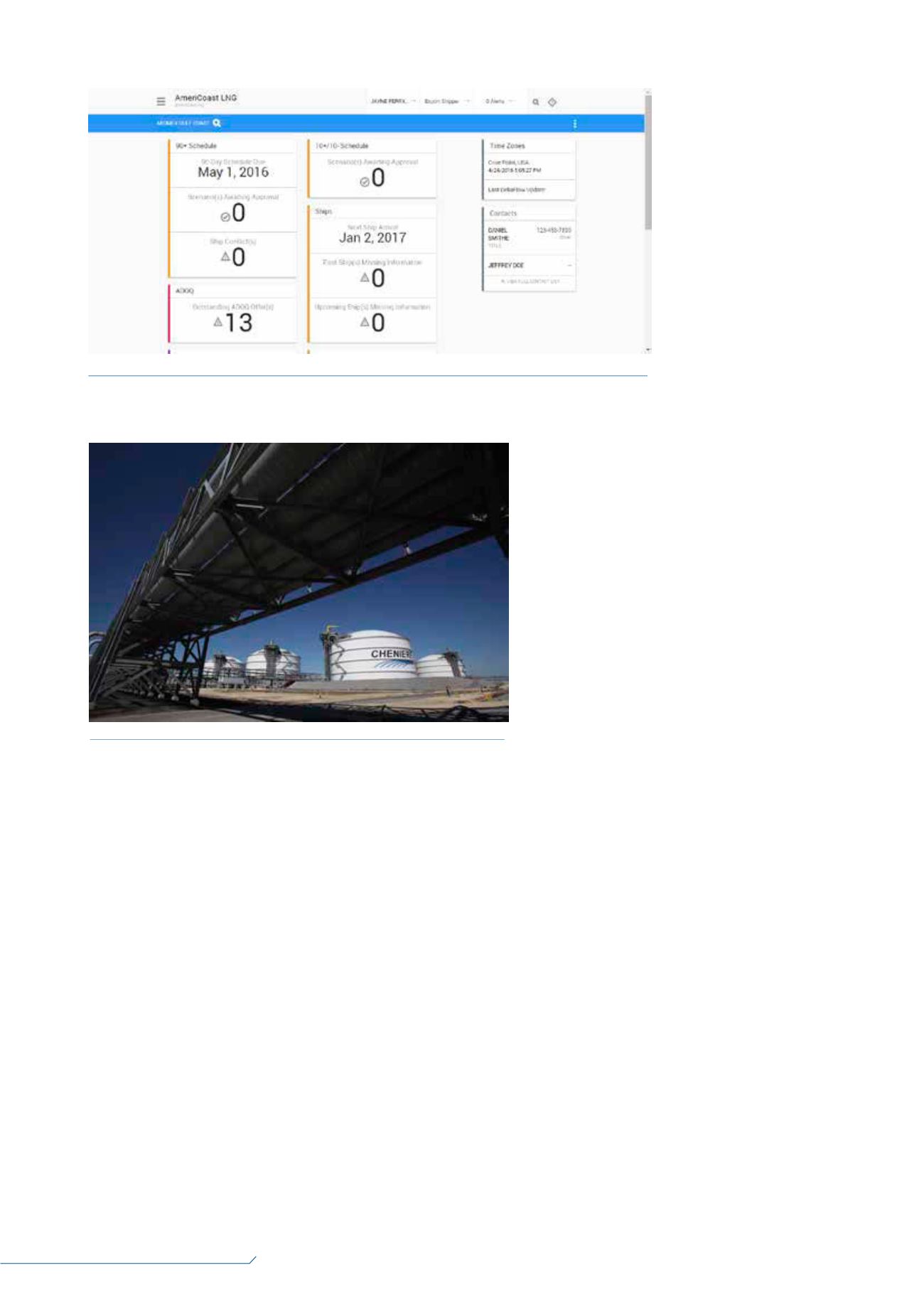
web-based dashboards (Figure 1) to assist both internal and
external users.
Maximising efficiency
Enterprise software for hydrocarbon and energy business
management is more readily available than ever before.
While some degree of customisation is characteristic
for energy companies whose commercial operations are
inherently complex, gone are the days of large scale custom
development. The market has shifted to favour configuration
over customisation to meet the critical demand for better
business agility and operational efficiency.
Figure 1.
myQuorum dashboard (image by Quorum).
Figure 2.
Storage tanks at Sabine Pass (photo by Cheniere Energy).


