36
LNG
INDUSTRY
OCTOBER
2016
Case study 1: Santos GLNG
Santos GLNG is a pioneering venture that produces natural gas
fromQueensland’s coal seams and converts it into LNG for sale
to world markets.
It involves ongoing gas field development in the Surat and
Bowen basins, a 420 km gas transmission pipeline, and an LNG
plant on Curtis Island near Gladstone, Queensland.
The project is led by Australian company Santos, in
partnership with Petronas fromMalaysia, Total from France, and
Kogas fromSouth Korea.
It exported its first LNG cargo in October 2015, and, when
fully operational, will have the capacity to produce 7.8 million tpy
of LNG.
The challenge
Core to Santos GLNG’s long-term business is the ongoing
development of natural gas wells in Queensland’s Surat and
Bowen basins. The construction of a well site begins with a well
pad, where the drilling rig sits and drills a well to extract gas.
Collected gas is then piped to compressor stations for treatment.
This work is handled by the Santos GLNG Upstream division.
On earlier projects, Santos GLNG engaged with its EPC
contractors to design its well pads individually and stick-build
them on-site. The Santos GLNG Upstream team identified an
opportunity to minimise the time and cost spent on individual
well pad design and initiated a project to develop the capability
to replicate a standard design and then reproduce all of the
required deliverables.
The solution
As a first step, a large EPC was engaged to work on the project.
The EPC was already using a range of Intergraph design tools
for instrument datasheets and loops, as well as for piping and
instrumentation diagram (P&ID) design. Additionally, Santos
is a long-time user of Intergraph solutions. The Santos GLNG
Upstream information team deployed these tools in-house so
that EPCs working on GLNG in the future could utilise them in
the Santos environment via a Citrix connection, minimising the
requirements at handover and ultimately saving time and money.
Once deployed, the Santos GLNG Information Management
team used the systems to create an ‘as-built’ of the asset, make
changes to existing facilities, and standardise well pad design for
replication. The teamwas enabled to use the specifications and
corporate standards within the software, enabling the quick and
easy design of fit-for-purpose skid packages to suit the coalbed
methane (CBM) industry in the current market.
The results
Owning the tools and bringing them in-house resulted in
improvements in quality, saving time and money. In addition to
this, the conformity of replication enabled standardisation across
many areas, including interchangeability and spares reduction.
Having the design tools hosted in-house allows Santos to
integrate other applications with the use of the data that is
captured in the tools and the embedded relationships between
data and documents.
The future
Santos GLNG Upstream has established a small, in-house team
to oversee and/or implement minor modifications to its own
facilities.
Key learnings
The following lessons should be learned from this case study:
When building a small, in-house team, the best people
should be chosen. Designers and administrators should not
only be technically proficient, but also capable of working
collaboratively.
There will always be a requirement for EPC engagement.
Having the tools in-house enables them to make changes
quickly, minimising the requirements for handover and
reducing the costs for delivery.
Find a data and rule driven design tool that is most suitable
and then mandate it across the EPCs so that they can use
it in the given environment. Hosting these tools centrally
will reduce administration costs and lessen handover
requirements for all parties.
Invest time and effort in the original template. Do not be
tempted to take shortcuts that may save time up front, but
could have significant effects downstream.
Case study 2: Leighton
Contractors
*
*
Please note that since the time of researching and preparing this
case study, Leighton Contractors has changed its name and is
now known as CPB Contractors.
Identifying goals
In 2012, Leighton Contractors was awarded two major
multimillion dollar contracts to build key gas and water
infrastructure as part of the first phase of the Australia Pacific LNG
gathering project – a CBM to LNG project that includes the
development of substantial CBM resources in the Surat and
Bowen basins; a 530 km transmission pipeline; and a multi-train
facility on Curtis Island, Australia. The contracts involved the
construction of gathering systems, which collect the water and
gas produced from individual wells for processing, and the
construction of water treatment facilities.
Overcoming challenges
This project required more than 1200 km of high density
polyethylene (HDPE) welded pipeline, 1700 km of fibre optic and
power cabling, and wellhead equipment to be managed across
six construction sites, with three sub-contractors involved in the
construction.
Adding to the complexity, the client required Leighton to
manage all materials – a somewhat unusual scenario. Typically, a
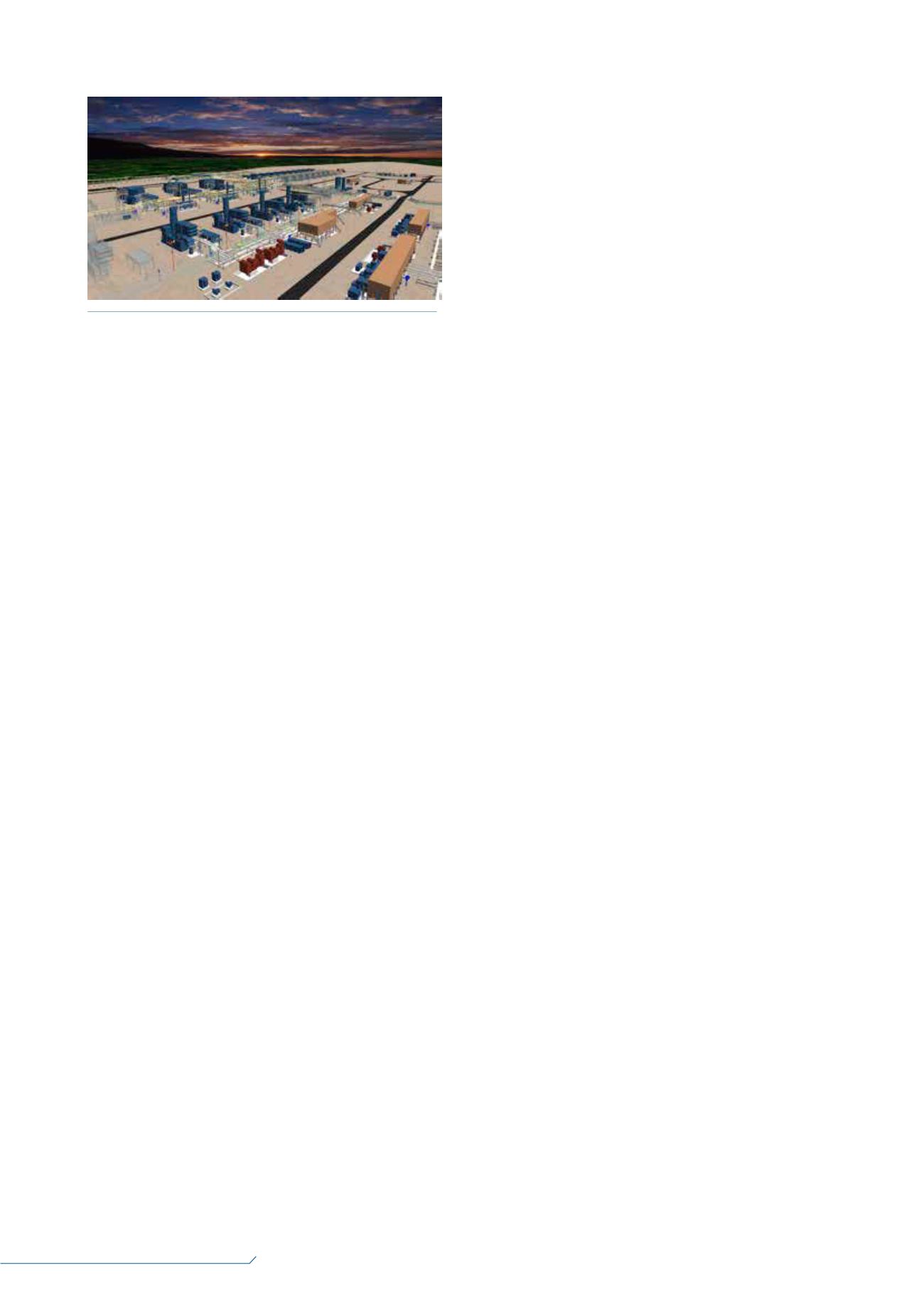
Figure 1.
An example of Santos GLNG’s design work executed
with Intergraph solutions.
©
Santos GLNG.


