The exact amount of heat input and BOG generated
and to be managed depends on a range of parameters.
The following are the most important:
The saturated vapour pressure of the LNG in the
unloading vessel.
The targeted saturated vapour pressure of the LNG
in the reloading vessel, which, in turn, depends on
the voyage the ship has to make, whether the ship
consumes BOG or not, and the maximal saturated
vapour pressure on its unloading point.
The composition of the LNG.
The LNG infrastructure itself, which is determined by
pressure losses during loading and unloading, and
thus heat input from the piping system, as well as the
required pump energy and the associated heat input.
In order to optimise the terminal’s BOG management
system, four additional reciprocating four-stage six-cylinder
compressors from IHI are being added on top of the
compressor capacity that has already been installed. These
compressors can be used either in low pressure mode (from
tank pressure up to 4 barg) or in high pressure mode (from
tank pressure up to 80 barg). When running in high pressure
mode, the gas runs through the four stages of the
compressor. In low pressure mode, the first two stages are
switched to stage one, while the cylinders of stage three
and four run idle.
Pluto LNG, image courtesy of Woodside
Our clients count on us to provide quality end-to-end
LNG services, on time and on budget.
Our 20,000 strong Oil & Gas professionals offer capabilities in:
›
Liquefaction plant build
›
Completions and commissioning
›
Non-process infrastructure
›
Marine infrastructure
›
Operations and maintenance
›
Telecommunications
›
Re-gasification and receiving terminals
›
Off-sites and utilities
›
Gas processing and handling
›
Pipelines and compressor stations
Proven LNG
Capabilities
SNC-Lavalin Kentz Field Operations is world
renowned for providing multi-disciplinary
construction and technical field services.
snclavalin.com
1290_SL16_OG_AD_IndustryLNG_V02_print.pdf 1 9/28/2016 1:53:06 PM
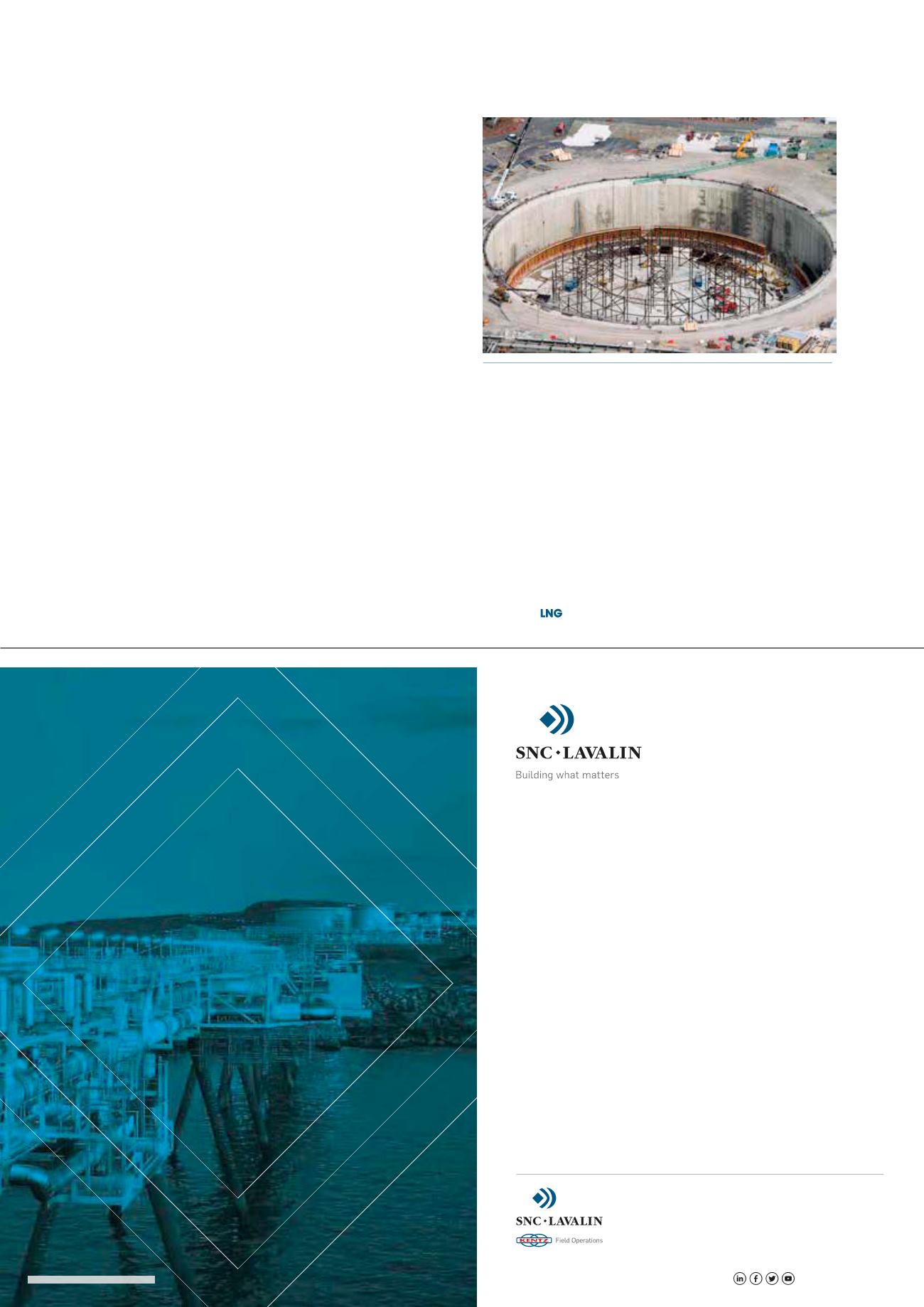
Figure 5.
The fifth tank pit, with construction of the outer tank
wall and metallic roof (Fluxys Belgium – P. Henderyckx).
Conclusion
Today, ship loadings with a loading rate of more than
5000 m³/hr are common business at the Zeebrugge
LNG terminal. With the second jetty coming into
operation in 4Q16, a multitude of services will be
added, including STS transfer. As from 2018/2019,
the LNG terminal will be ready for large scale
transshipments, either STS or ship-to-storage-to-ship,
with loading rates similar to those in an export
terminal.


