24
LNG
INDUSTRY
OCTOBER
2016
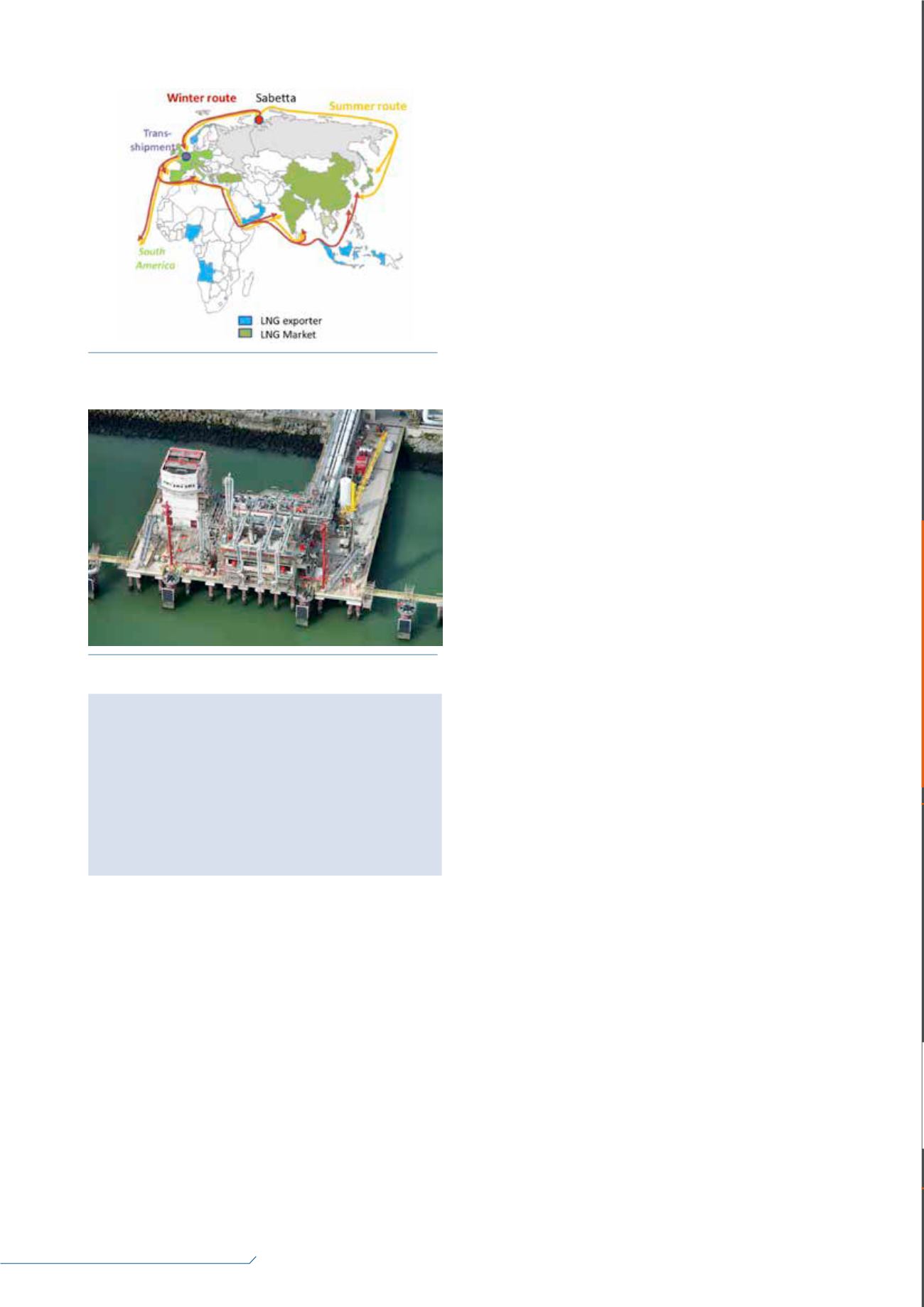
optimal destination flexibility for Yamal’s ARC 7 fleet
from the Sabetta port in Russia. The fleet will take the
western supply route during the winter, and both the
western and eastern routes during the summer (Figure 1).
Other important factors in the selection process were
steady meteorological conditions and a quasi guaranteed
nautical access. The LNG terminal in Zeebrugge, which is
located in a sheltered area of the port, provided excellent
statistics for both of these criteria.
Second jetty
In order to have full flexibility, Yamal LNG was looking
for an LNG terminal with two jetties, allowing for
the direct ship-to-ship (STS) transfer of LNG. When
the transshipment contract was signed, the second
jetty (Figure 2) was already under construction at the
Zeebrugge terminal (Techint Sener LNG (TSLNG) was
awarded the engineering, procurement and construction
(EPC) contract) and, by the time this article is published,
the first ships should have already moored, or will be due
to arrive at the jetty. If an ARC 7 vessel and a reloading
vessel can be scheduled to moor at both jetties at the
same time, the LNG and boil-off gas (BOG) are able to
flow through the LNG terminal’s piping and equipment
from one ship directly to the other. The second jetty will
add a number of services to the terminal’s portfolio,
including the following:
Direct STS transfer (in this stage still with a lower
BOG compressor capacity).
Simultaneous loading and unloading services.
Services for small scale LNG vessels.
Figure 3 shows the overall layout of the terminal. With
regard to services for small scale LNG vessels, it is worth
mentioning that the jetty is designed for ships with a
capacity as small as 2000 m³ up to Q-Flex size with a
capacity of 220 000 m³. Furthermore, a 5100 m³ bunker
vessel owned by Engie, Mitsubishi, NYK and Fluxys LNG
will operate using the Zeebrugge terminal as its home
port. There, it will load LNG at the terminal and bunker, in
a first stage, to the new LNG-fuelled carriers from
United European Car Carriers (UECC), which will sail to
Zeebrugge on a regular basis.
Dedicated storage tank
For instances where the two jetties are not available at
the same time, a dedicated storage tank with a working
volume of 180 000 m³ is being built to allow additional
operational and logistical flexibility. The ARC 7 vessel
can then unload its LNG into the storage tank and a
reloading vessel can reload at a later time, without being
impacted by operations at the other jetty. In order to
ensure a fast reloading process, the tank will be equipped
with five high flow in-tank pumps and a classic low flow
pump for send-out and cold circulation purposes. These
pumps guarantee a high loading flow similar to an export
terminal.
Building specifications
The building permits in Zeebrugge limit the building
height to 24 m above grade level so the tank had to be
semi-buried. Firstly, a diaphragm wall was constructed,
after which a pit with a depth of approximately 23 m was
dug on the inside of the wall, removing 190 000 m³ of
sand (Figure 4). In the pit, the tank is being erected as a
classic full containment tank. Due to the limitations on
height (permitting) and depth (geotechnical reasons), the
tank is rather flat in comparison with other storage tanks.
The diaphragm wall has a diameter of 102 m, the outer
tank diameter measures 95 m and the tank will be 45 m
high, measured from the top of the foundation to the top
of the cupola. The walls of the diaphragm reach down
to the clay layer, approximately 35 m below grade level.
The pit is made water-tight by the diaphragm walls on the
sides and by the clay layer on the bottom.
Project development
On 1 April 2015, Fluxys LNG signed an EPC contract
with a joint venture (JV) consisting of Duro-Felguera,
Specific design features
Specific design features of the second jetty include a
dedicated small 8 in. (un)loading arm with 6 in. vapour
return (next to the three liquid + one vapour 20 in. arms),
long fenders (allowing sufficient fender contact for small
vessels at low tide), a big and a small ship gangway
(allowing access to small vessels at low tide), electric
37-way or five-way and fibre optic six-way or two-way
ship-to-shore links.
Figure 2.
Second jetty (Fluxys Belgium – P. Henderyckx).
Figure 1.
Winter and summer routes of LNG from Sabetta.


