20
LNG
INDUSTRY
OCTOBER
2016
In the last decade, the LNG supply contracts have started to
allow for greater flexibility to be more in line with the demands
of today’s customers. Many LNG offtakers face seasonal
demand fluctuations due to the summer air conditioning loads
or the winter heating season, which they would like to see
reflected in their contracts. Pricing LNG to major pipeline gas
benchmark prices has been suggested as an alternative to oil
price indexing, especially during the time when oil prices were
approximately US$100/bbl. LNG producers regularly have spot
cargoes available that are excess to contracted supplies. These
spot cargoes are usually sold through tenders. With more LNG
producers in the market, the number of spot cargoes also
increased. Seeing an opportunity for trade, commodity traders
such as Gunvor and Vitol have entered the LNG market, buying
and selling LNG cargoes around the world. A number of oil
majors have also begun to trade LNG on a portfolio basis;
cargoes from their own LNG plants and from positions they
have taken in other LNG plants are distributed to their offtakers
and to spot cargo buyers. All of this has increased the liquidity in
the LNG market.
In 2015, approximately 28% of the total LNG volume was
traded on a spot or short-term basis against 16% in 2006. This
allows LNG buyers to optimise their LNG supplies, using
long-term contracts to cover most of the demand and spot
cargoes to adjust for seasonal fluctuations and exploit the
opportunity to save money when spot prices are low. These
spot and short-term cargoes also require shipping from the LNG
plant to the offtaker. LNG ship brokers are working to match up
the shipping demands for these cargoes with the LNG carriers
available in the market. With well over 100 ships still to come
out of the shipyards and into the market, which is short on
cargoes and long on LNG carriers, LNG ship brokers will be
spending a significant amount of time trying to keep all of these
ships trading.
The short lived golden age of
gas
Methane has the lowest CO
2
emissions per energy unit when
combusted compared to other fossil fuels, such as gasoline,
diesel and coal. Therefore, LNG, which is predominantly
methane, is the most environmentally friendly fossil fuel. In
this time of growing environmental awareness, the future
seems bright for LNG. In 2011, the International Energy Agency
(IEA) pronounced the golden age of gas.
1
In the US, the shale
revolution was just starting to bring untold amounts of cheap
gas to the market, ripe for export as LNG. In Australia, large LNG
plants were under development, slated to bring 65 million t of
LNG to the market. China’s booming economy required a
significant amount of fuel, and LNG was one of the fuel sources
that the country selected. Following the temporary shutdown
of the Japanese nuclear power plants in the wake of the
Great Tōhoku earthquake in 2011, Japanese power producers
turned to LNG to make up the difference. Already the leader
in LNG imports at the time, Japan increased its imports by
20 million tpy to approximately 90 million tpy. LNG prices rose
and LNG shipping rates climbed too. During this period, oil had
been hovering around US$100/bbl. High oil prices translated
into higher LNG prices via the oil indexing, which was hurting
LNG importers even more. Seeing the growing disparity
between oil and gas pricing, importers started to request a
gas-to-gas indexing when renewing LNG supply contracts, in
the hope that they would be able to keep the energy cost rise
under control. For a moment, the future of gas seemed golden.
Then came mid-2014 and a perfect
storm hit the LNG market. Oil started a price
slide from US$105/bbl in June 2014 to less
than US$30/bbl in January 2016. China’s
booming economy started showing signs of
slowing down. Meanwhile, Japan was
scaling back its additional LNG imports. The
same US shale revolution that brought
massive amounts of gas to the market also
brought equally massive amounts of oil to
the market. The Organization of Petroleum
Exporting Countries (OPEC) saw its role as
the leading oil supplier challenged and
responded by flooding the market with oil in
order to drive out the US shale producers.
Oil prices dropped rapidly due to the excess
oil supply in the market. LNG prices started
dropping too for two main reasons: oil
indexing and excess supply. The price of
LNG dropped through oil indexing and
because the increased LNG volumes that
became available on the market were no
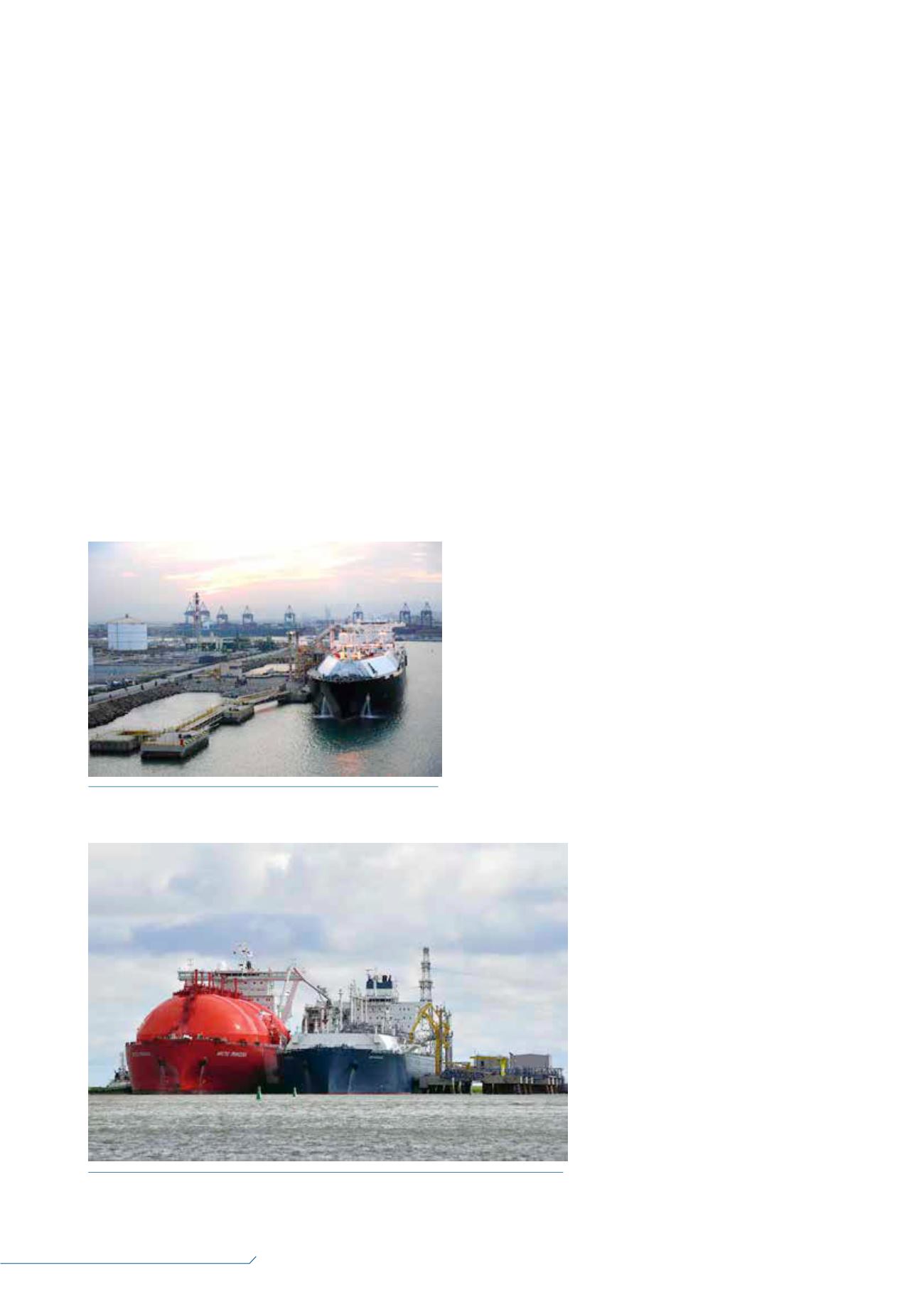
Figure 1.
The traditional LNG wholesale business: an LNG
carrier docked at an LNG terminal (source: Shutterstock).
Figure 2.
A floating storage regasification unit (FSRU) providing a quick start to LNG
imports for countries seeking energy independence or wanting to import cheap energy
through LNG (source: Shutterstock).


