Market overview
A combination of sustained low oil prices and
lower than expected economic growth profiles of
many Asian countries (particularly China) has led
to oversupply in the market, causing LNG spot
prices to fall substantially. Asia will continue to
be a key region of demand growth, yet prices
have struggled. In August 2016, Japan’s LNG spot
price averaged US$5.40/million Btu – a 50%
decline compared to the same period 12 months
prior. The low oil price remains a concern for the
LNG market, as most long-term LNG contracts
are linked to oil price, with the flexibility to vary
according to market conditions greatly reduced.
With long-term contracts in place, LNG suppliers’
ability to swap cargoes to the highest-priced
bidder, or to adjust their LNG trading to where
they can gain the most profit, is restricted.
Douglas-Westwood (DW) forecasts that
CAPEX on LNG facilities between 2017 and 2021
will total US$284 billion – an increase of 50%
compared to the previous five years. Over the
forecast period, the Middle East will experience a
30% compound annual growth rate (CAGR) and,
overall, the region will account for 3% of global
expenditure.
While the Middle East has historically been a
net exporting region, in recent years there has
been a clear rise in domestic gas consumption,
with two cargoes of LNG from the Sabine Pass
LNG plant delivered to Kuwait and the UAE in
2Q16. However, import projects will remain in the
minority over the forecast period, accounting for
only 7% of regional expenditure.
Conclusion
In recent years, oversupply within the market has
increased due to weaker demand from Asia. This
is likely to remain the case in the short-term due
to additional export capacity from Australasia
and North America. However, seasonal gas
demand will remain a key driver, particularly
in Western Europe and Latin America, as LNG
demand in these regions is often driven by
prolonged winter seasons, while declining local
gas production will also play a part. Global LNG
CAPEX will experience a 14% CAGR over the
next five years, and the use of natural gas will
continue to play an increasingly important role in
meeting global energy demand.
Qatar retained its position as the world’s
largest exporter of LNG in 2016. However, DW
expects to see a shift in the market, with Australia
forecast to become the biggest supplier by the
end of 2017. With many countries in the
Middle East having large gas reserves, ongoing
political tensions and proxy warfare are a big
stumbling point for the development of these
capital-intensive projects, hence curtailing further
investments over the near-term.
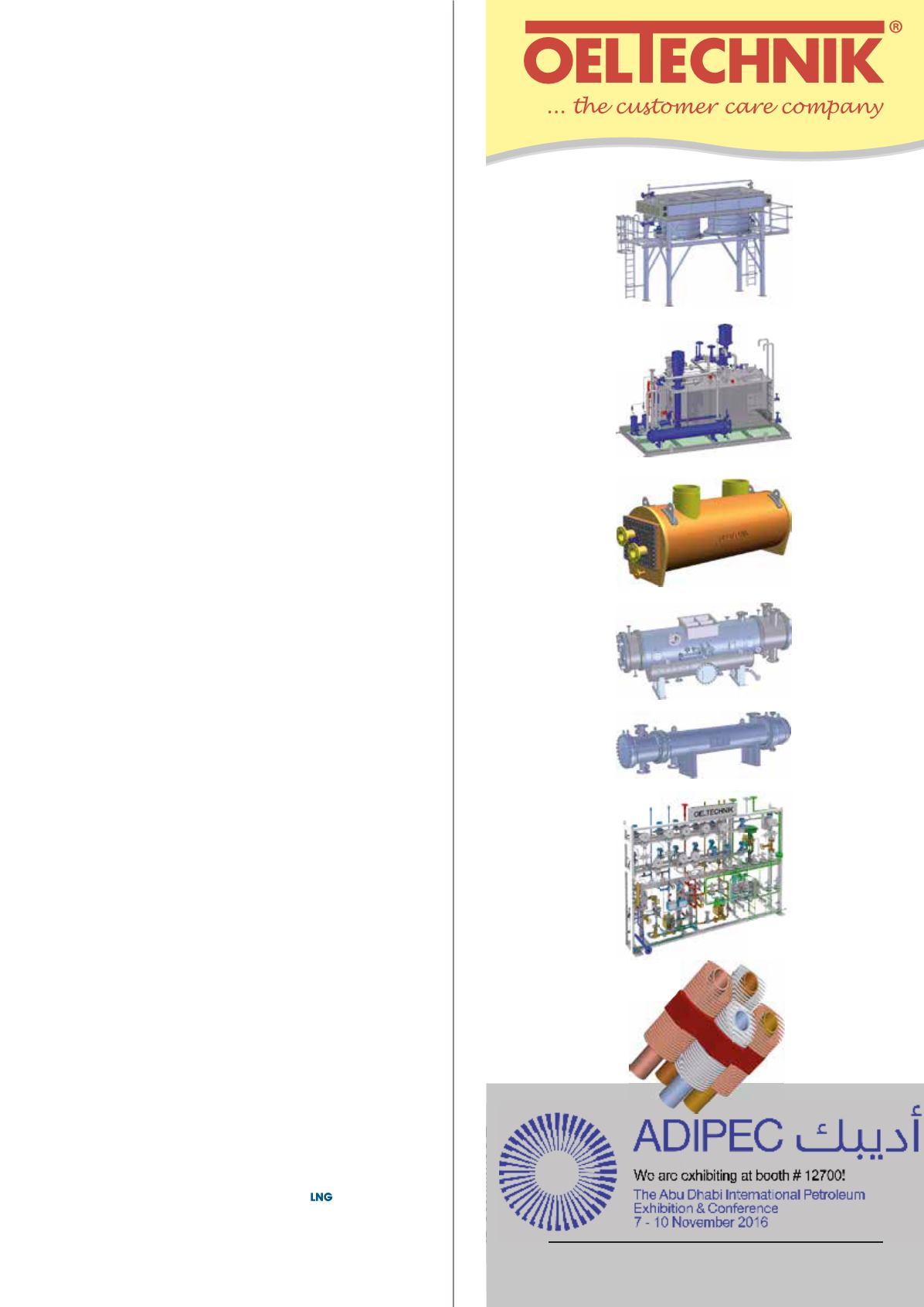
All auxiliary equipment out of one hand ...
Oil
consoles
Enhanced
surface
element
cooler
Surface
condenser
systems
Shell and
tube
Air-cooled
heat
exchanger
(Fin Fan)
Dry seal
gas panel
Finned
tubes
All auxiliary equipment out of one hand ...
Oil
consoles
Enhanced
surface
element
cooler
Surface
condenser
systems
Shell and
tube
Air-cooled
heat
exchanger
(Fin Fan)
Dry seal
gas panel
Finned
tubes


