16
LNG
INDUSTRY
OCTOBER
2016
Over the same period, when the construction of
export facilities thrived within the region, import facilities
have been practically restricted to floating units, with the
exception of the Marmara Ereğlisi (1994) and Izmir Aliağa
(2006) land-based import terminals in Turkey. Israel,
Jordan, Kuwait and the UAE have all deployed floating
import units over the past eight years in order to meet
increasing domestic demand for natural gas. The use of
LNG for power generation in the region has been rising
over the past decade. This trend is forecast to continue,
with Bahrain and Lebanon expected to commission their
first floating import unit over the 2017 – 2021 period.
Middle East in focus
The Middle East is currently the largest LNG exporting
region in the world, with six operational facilities that
run on 25 trains. However, the majority of these facilities
came onstream prior to 2011 and export levels are
expected to remain at current levels for the foreseeable
future as Qatar’s North Field production moratorium
remains in place. No liquefaction terminals are
expected onstream in Qatar within the forecast period.
Consequently, Australia is expected to overtake Qatar as
the world’s largest exporter by the end of 2017, and the
US soon after the forecast period.
A major influence on expenditure in the region over
the 2017 – 2021 period will be developments in Iran.
With the lifting of US, UN and EU nuclear-related
sanctions, investment is expected to gradually stream
back into the country – potentially restarting Iranian LNG
plans.
The majority of Iran’s planned LNG projects have been
stalled or suspended due to the impact of economic
sanctions. The Iran LNG project is currently the only
project under construction, comprising two LNG trains,
each with a capacity of 10.5 million tpy. The facility, which
is reported to be over 60% complete, is expected to be
operational by 2019. Other liquefaction expenditure is
associated with the prospective completion of other LNG
projects in Iran that were stalled due to the international
sanctions. The revival of these stalled projects (Pars LNG
and Persian LNG) should guarantee that the Middle East
remains the world’s largest exporter of LNG for the
foreseeable future. However, the financing structure of
these abandoned projects is currently unclear. The only
other expenditure on export facilities in the region over
the forecast is expected to be the replacement of the
Das Island 1 facility.
Export capacity in the Middle East over the
2012 – 2016 period remained at 100.1 million tpy.
However, this is expected to
increase to 110.6 million tpy
by 2021, driven by the
construction of the Iran LNG
terminal. However, due to
large increases in capacity in
Australia and the US, the
Middle East’s market share
of just over 28% in 2016 will
fall to 23% by 2021.
Despite the region being
a major exporter of LNG, a
couple of import terminals
are expected to be built
– with Turkey accounting for
the majority of expenditure
on import facilities. Another
potential import project
within the region is the
Kuwait National Petroleum
Corp. (KNPC) LNG facility in
Kuwait, which is expected to
come onstream by 2020.
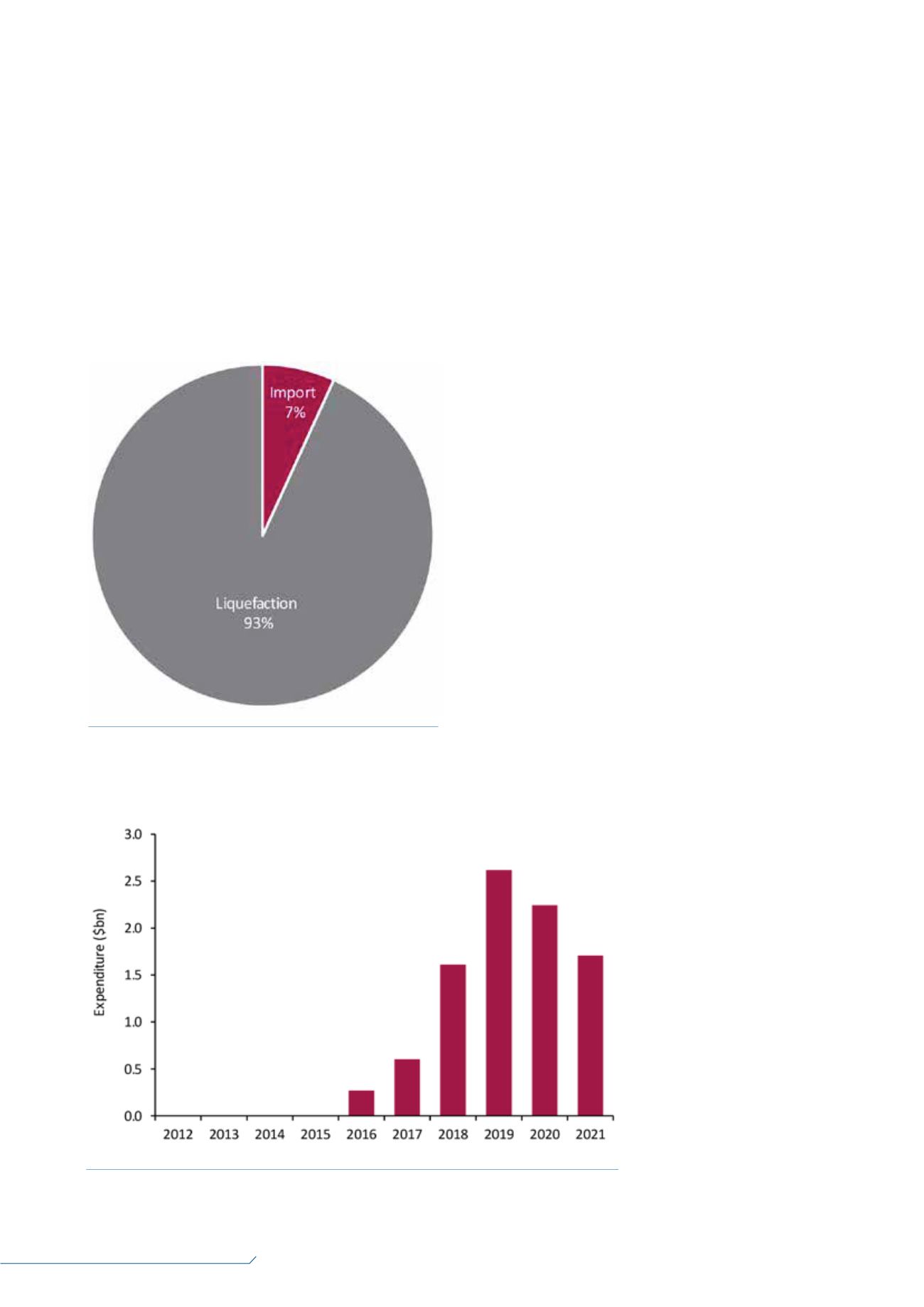
Figure 2.
Middle East expenditure 2012 – 2021 (source: Douglas-Westwood, ‘World LNG Market
Forecast 2017 – 2021’).
Figure 1.
CAPEX on LNG facilities in the Middle East
2012 – 2021 (source: Douglas-Westwood, ‘World LNG Market
Forecast 2017 – 2021’).


